Save this article to read it later.
Find this story in your accountsSaved for Latersection.
I always played Peanut Brittle.
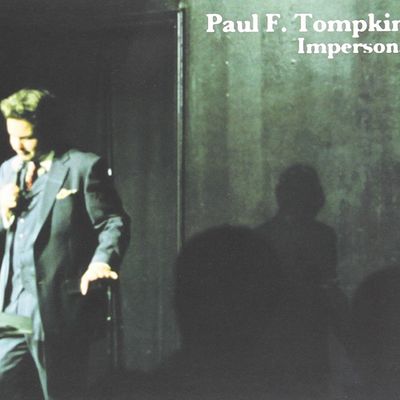
It comes fromPaul F. Tompkinss 2007 albumImpersonal.
To me, though, every thought a comedian has is personal.
Most people see a family movie on at midnight and produce no interesting thoughts whatsoever.
It just floats through their mental drain pipe with the rest of the days sensory input.
In Tompkinss mind, however, it stuck, and the result was a scenario only he could conceive.
Who cares if its not an anecdote from his life?
Its as unique to Paul as his fingerprint.
So is Peanut Brittle.
Listen to it before you read another word.
The writing in Peanut Brittle is as surprising as the subject matter.
Paul, however, doesnt care at all if he soundsnatural.
Oh, my heart is beating like a jackrabbit!
he says at one point, like no one you haveever met.
Yet he never forgets that comedyrequires brevity.
Talk show bookers tell you to get your first laugh by the forty-second mark.Paul gets his in six.
The only way to get it faster is to fall into a pie.
Paul gets six laughs in his first minute.
There are bits whereGeorge Carlindoesnt get six laughs intenminutes.
Its not just impressive for Paul, its necessary.
If it delivers laughs like this, I want more.
In that very same first minute, Paul establishes a rhetorical tactic that he maintains through theentire piece.
Every single sentence in Peanut Brittle is ironic.
Most standup bits have at leastone setup line where the comic tells you their sincere point of view.
At no point does Paul do this.
The words of PeanutBrittle as written are those of someone completely taken in by the prank.
Its only his tone that shows he thinks its the dumbest thing ever.
He sarcastically yells What a great prank!
He notes that theychanged the packaging font to be more modern, ironically bellowing because THAT was theproblem!
All the while his sentences are, on the surface, positive.
The whole performance is acomedians voice at war with his own words.
An almost six-minute piece written entirely ironically would not be remarkable in poetry or anessay collection.
For standup, this is a towering achievement.
Most comedy bits have nothingunifying the words at all except that fifty drunks laughed at them between pretzel bites.
Its justa collection of the shit that stuck when the comic threw it at the wall.
A bit must pleasea live audience every night.
A unifying conceit of any kind is a luxury a comic cant oftenafford.
A bar band is never like, Wouldnt it be cool if every song was in the same key?
Theyjust dont want to get bottles thrown at them.
Once the crowd is on board, Paul jams the premise in hard.
He does this, of course, by ironically proclaiming how common it is.
The audience, now fully awareof the game, loves it more every time he does it.
Heembodies every emotion of the victim, from trust to horror to shame.
the crowd agrees and gives him a well-deserved applause break.
He has achieved the foundational goalof standup comedy.
They noticethings like the canned peanut brittle gag having no basis in reality.
Things like this dont juststand out to a comedian.
The absurdity is maddening.
Pointing it out toothers is futile.
Their friends think they are weird and pull away.
Comedy is the solution to this alienation.
Suddenly your oddness doesnt repel people, itmakes them happy.
The way you were made now has value to your fellow humans.
Thisacceptance is a profound relief.
Even so, getting others to understand yourunorthodox thoughts ishard.
Paul must use everything hes ever learned about writing and allthe acting passion he can summon.
His efforts pay off.
When hes done, the audience hasconnected with him on a deep level.
They see the prank the way only Paul ever did before.Theres nothing more personal than that.
He is on Twitter at@johnroycomic.
