Save this article to read it later.
Find this story in your accountsSaved for Latersection.
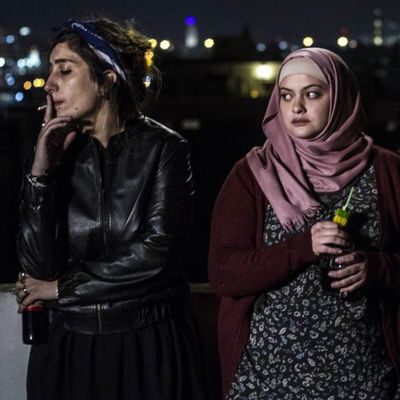
They are Palestinians in an Israeli city, women in a world run by men.
Are you scared?I dont get scared.
If these people want to do something against me, theyll do it.
Some people never take action in their lives.
Im doing what I need to do, and I cant be scared.
I always had a passion for writing and making plays at school.
But this desire was stronger than me.
My parents were in Canada.
I met my producer Shlomi Elkabetz there he was my teacher.
I started filming my final project and writing a script forIn Betweenwhile at school.
I graduated in 2011.
Then Shlomi and I founded our company, Deux Beaux Garcons Films, with his partner.
They are pro-Palestinian, gay Israelis and we are activists in the film industry.
Its a very low-budget production anyway, lower than most low budgets in the world.
There is no funding for us as artists in Palestine.
How did you come up with these specific characters?
The setup of three characters is interesting, dynamic-wise.
I liked the idea of having a complex story that evolves.
These stories are also mine my ideas, my emotions, my community.
For example, Laila resembles me.
Over 75 percent of Palestinian women living in big cities are single.
Palestinian cinema is usually very nationalistic a mirror to the processes in society at every level.
I want to tell these stories as a Palestinian woman from the inside.
Our generation doesnt have a representation outside of these mainstream narratives.
[Now] the narratives are moving away from the conflict.
Now were in a phase that is more mature, though were a small society.
In Palestine, there are even more women filmmakers than in other countries in the region.
Its a positive thing and I hope theres more.
But of 33 Israeli films this year, only two were Palestinian directors.
In terms of quantity, our production is still low.
At first, during the revolts, men and women were equal together.
But the protests were repressed and women were discriminated against.
There is an awareness and deep change happening.
Conscience only moves forward.
But the outcomes havent become clear for the region.
And Palestine is still in darkness; its very weak.
Women have to change the men in leadership, or else the situation will never change.
Youre vocal about your role as a feminist and activist.
As a radical feminist, she is a guru, in the lineage of Simone de Beauvoir.
She is a pioneer who has sacrificed for her thought and for the cause.
For other women to imagine themselves living a different life, you have to suffer.
And Ahed Tamimi she grew up within this struggle.
Shes a new icon for young womens struggle, which is excellent.
At the moment, we are in a global regression, but there are movements of change.
There are more and more independent, educated women.
Many women have worked hard for this, and now we see the difference.
Ive even seen the effect of the movie within Palestine, and abroad where younger audiences are attending.
Its slow but still, I see change.
Your story is very intimate, and yet connects with the political in a powerful way.
The air you breathe is political.
When we say we want to change the system and we want women to rule this is very political.
The movie says there needs to be a change, and change is political.
They chose their lives.
They took responsibility and paid the price for it.
This interview has been edited and condensed.
