Save this article to read it later.
Find this story in your accountsSaved for Latersection.
Without being a topiary.
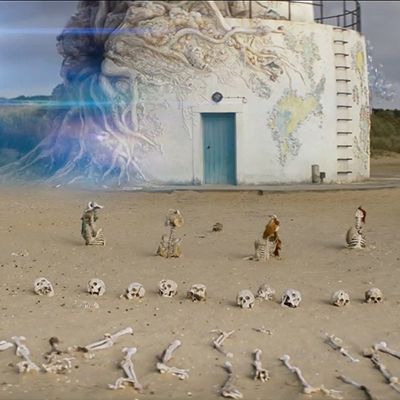
It has to give the notion that we wanted: that it was human-esque, but not human.
Also, from a different angle, you dont see them.
But if you come up the right angle, they become people.
He lets out an almost imperceptible sigh.
I think Alex described it as going from suburbia to psychedelia, Digby recalls.
We went off on our own to the script, Digby recalls.
The keyword for everything Lena and her cohort sees ismixing.
Digby says they wanted to take the concept of mixing to an extreme conceptual degree.
What would happen if a plant acted like a sound wave?
Or electricity or fire did?
A mineral might grow in an organic way.
Something organic might grow in a geometric or a crystalline way.
They were doing much of what they do, but in the wrong way.
The results can be gorgeous and unlike anything a human might dream up on their own.
Take, for example, the cave beneath the lighthouse that Lena arrives in at the films conclusion.
It gives off a vibe almost like an insects hive, but Digby says its all numbers.
The cave is a Mandelbrot explosion, he muses.
Gradually, you get an image that looks like a berry.
If you allow this berry, its mutating outwards, then you get a void thats left behind.
That is our cave and its structures.
Its a repetition of a pattern in three dimensions.
Digby says the tendrils werent actually inspired by anything organic, but rather by ice.
Its like a growth thats overtaken these Alaskan lighthouses.
That greatly influenced that whole growth on the outside.
Digby says it was a long while into the film before they had it nailed down.
Of course, we looked at the Aurora Borealis.
The Bear
We have to talk about the creatures.
A key goal, Digby says, was to make it as sad as it was scary.
We didnt want it to be a bear.
It had been destroyed and changed.
Also, things had grown cancerously.
Half its face is missing, as if youd had cancer of the mouth.
Another feature we looked at was changes in pigmentation, Digby says.
The plants that they first see, a lot of them are white.
The alligator-shark is white, its all devoid of its normal pigmentation.
The Stomach
Another gross-out moment comes when the group finds footage of a previous expedition.
We looked at decaying people and how maggots and other bugs overwhelm your body, he says.
The Man-Wall
The man with the stomach-growths meets an untimely end, but his body doesnt stop growing.
Lena and the crew find that his corpse expanded out into a wall-sized explosion of color and branching lines.
That started off as a rock, a crystalline rock thats been cut in half, Digby recalls.
They radiate out and they mimic the growth of trees and the rings of trees.
Then we also imagined that it would have some organic growth, which is feathering out afterwards.
Thats where Digby encountered another mathematical concept: a Lichtenberg figure.
Digby and Garland opted for something like an organic Lichtenberg with the dead mans expanded body.
Its very much like those pictures from space of rivers with all their tributaries coming out.
We took that as an inspiration as well.
Its not an explosion, but its something thats happened that makes it grow further and further away.
Things get separated and things grow in odd and fearsome ways.
It was about replication, but not full and exact replication, Digby says of the humanoid.
It was having the feral-feeling similarity of a tumorous humanoid, but not fully.
You feel its a physical ghost of humanness.
Its in a stage of becoming something else or someone else.
There were early discussions about giving it a face, but we threw that out at some stage.
Area X was shot in England, but is supposed to look like an American swampland.
That was in a quaint little pond in a very British park owned by the queen.
